
Last updated October 16, 2026
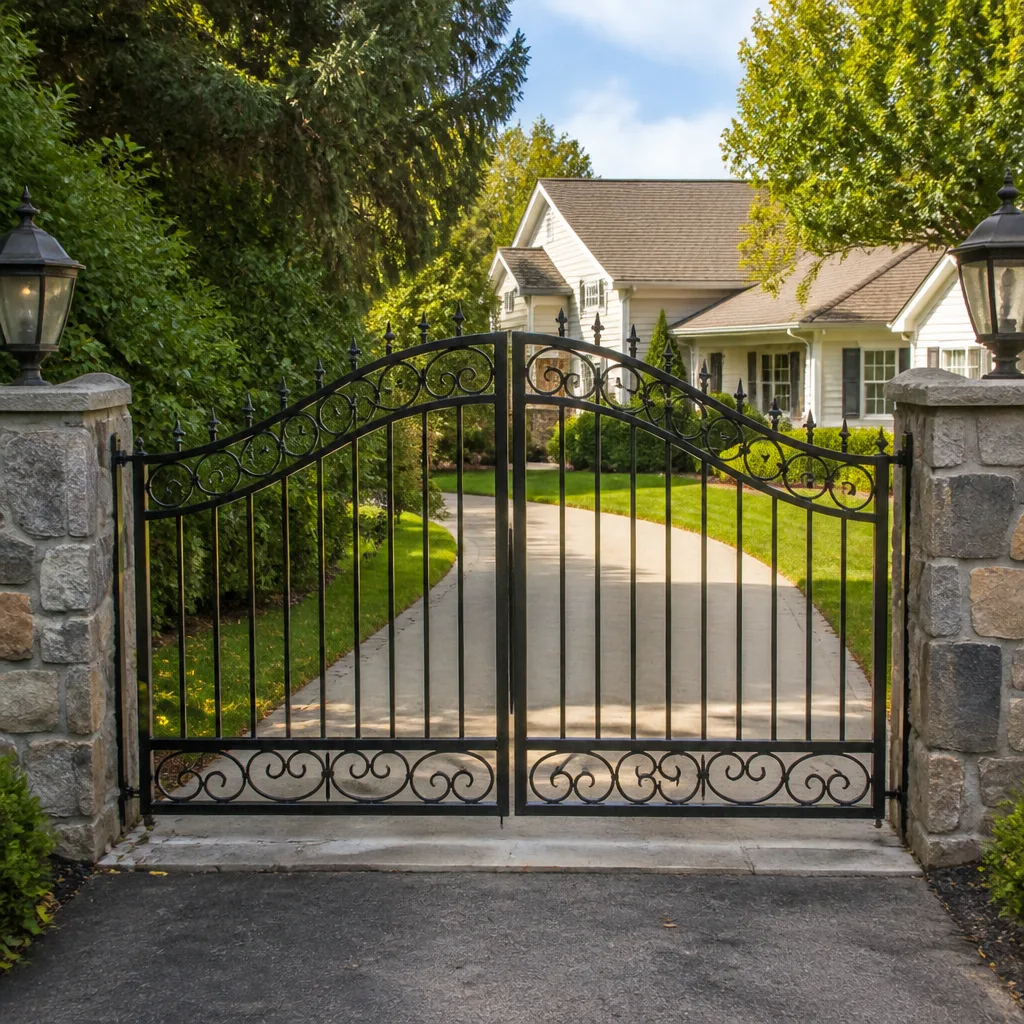 Wrought iron
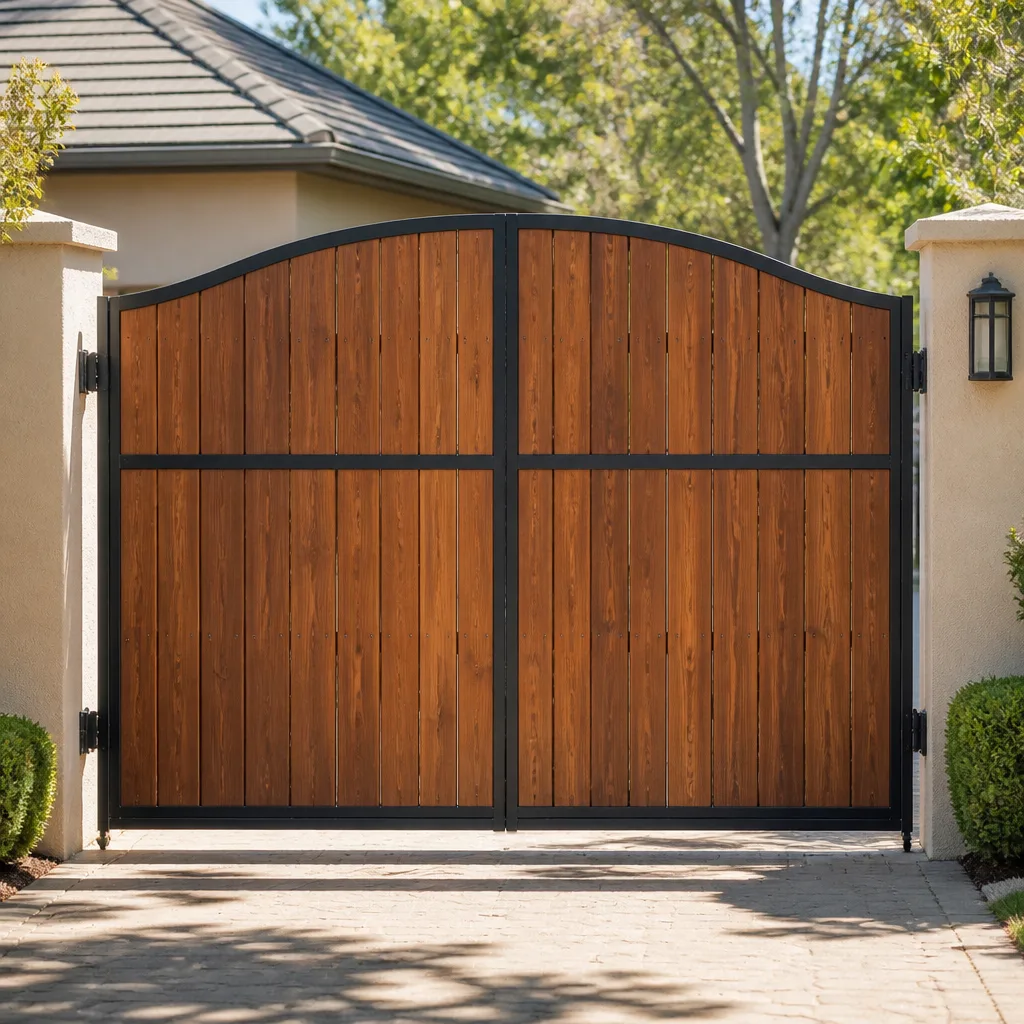 Wood & steel frame
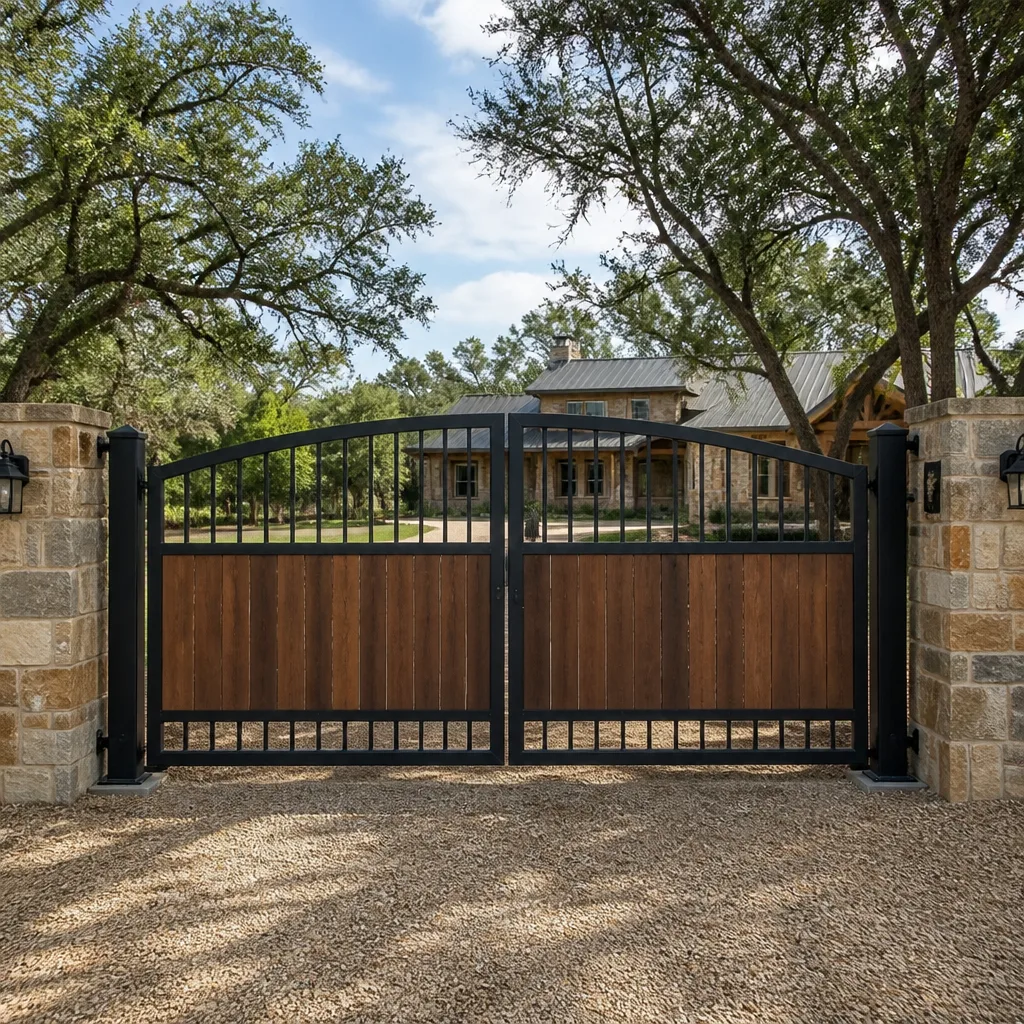 Farm & ranch
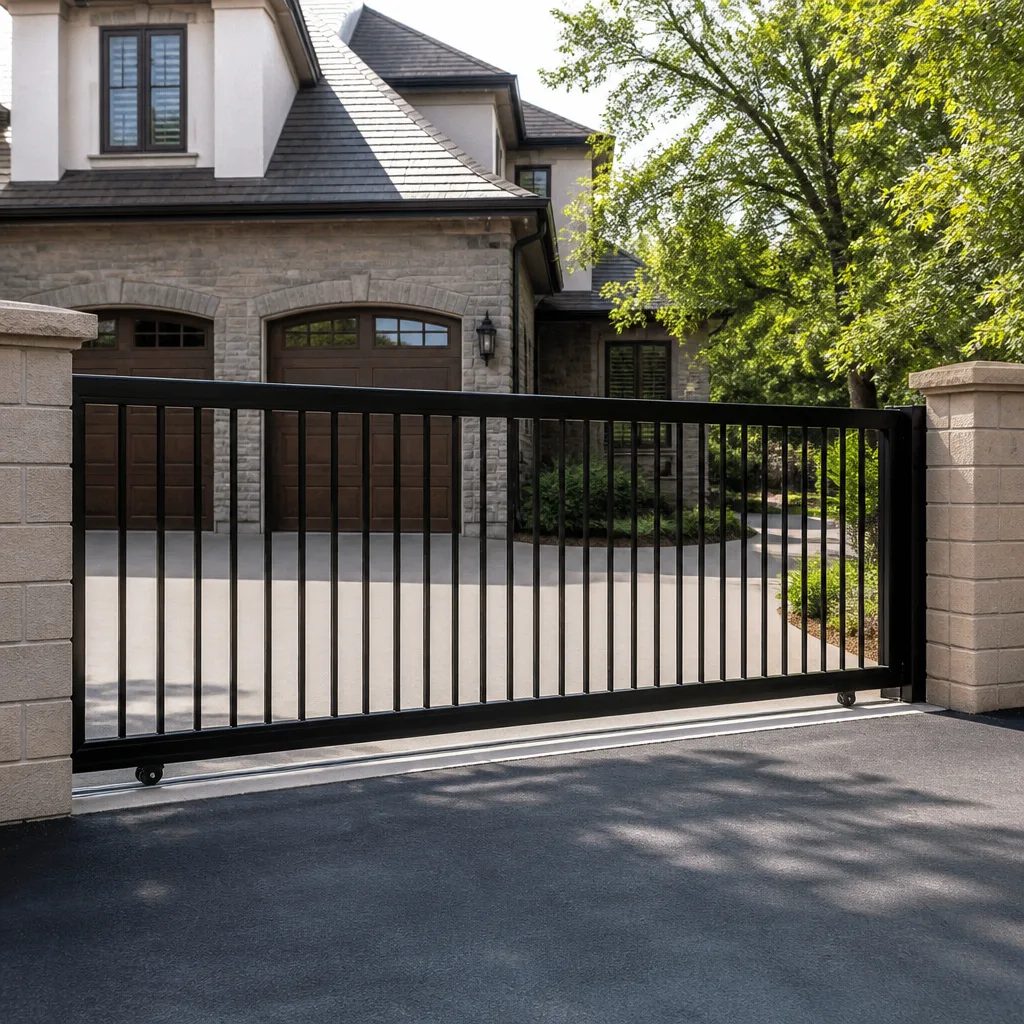 Sliding driveway gates
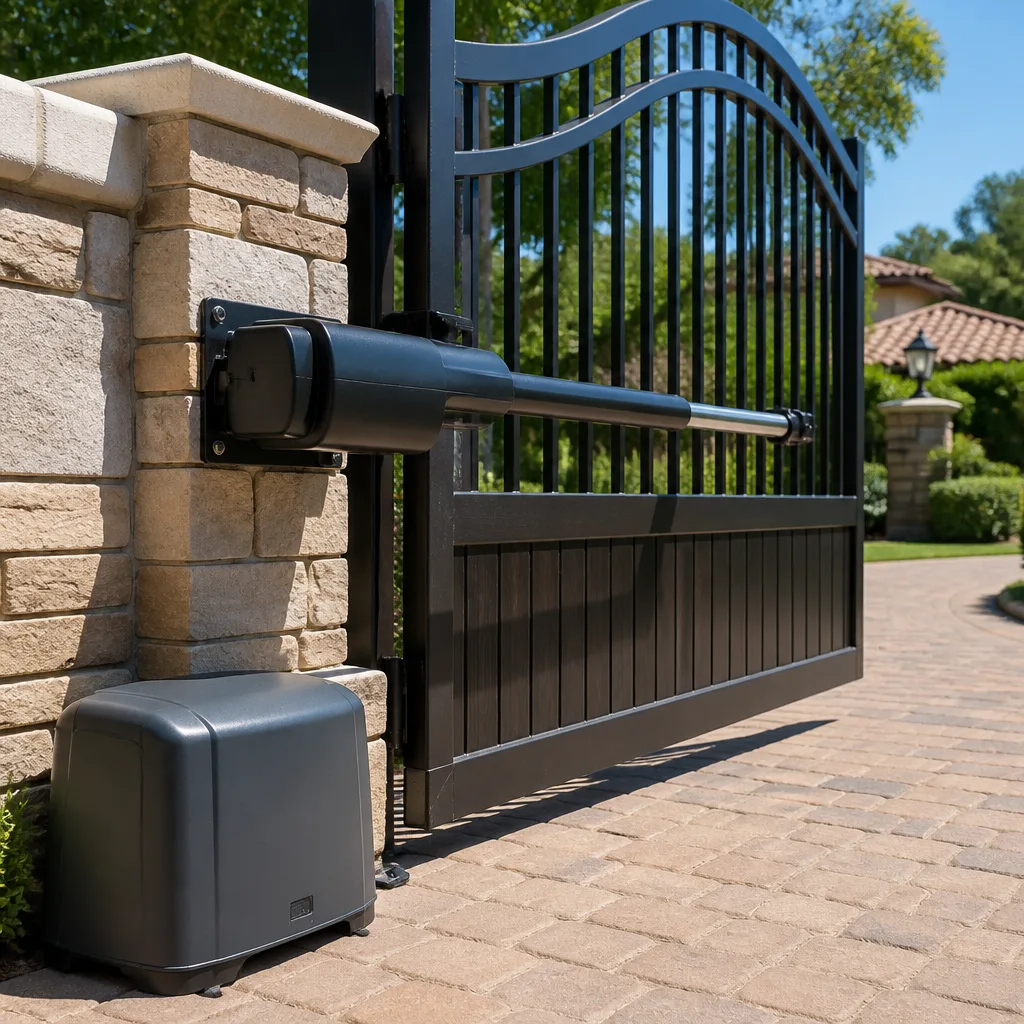 LiftMaster operators
Free on-site gate assessment - hinges, posts, and your LiftMaster or Nice gate operator checked before anything is quoted
The assessment is free and the quote is the invoice.
Get your free estimateThe Complete Guide to Gate Repair in Orange County
A gate that opens fine every morning can still be weeks away from a $900 motor failure. The worn hinge quietly overloading it never showed up on anyone’s invoice. That’s the frustrating reality of gate ownership in Orange County, and it’s why most homeowners end up paying for the same problem twice. This guide maps all three layers of your gate system so you can diagnose smarter, hire better, and understand exactly what’s happening behind that keypad, and you’ll find more guides & resources on our blog.
Quick Answer
Our Gate Repair services in Orange County CA typically cost between $180 and $650 for most mechanical and electrical issues, with opener motor replacement running $450 to $1,200 depending on brand and horsepower. The key to not overspending is understanding that every automatic gate is actually three independent systems: mechanical, electrical, and safety. A repair that fixes one while ignoring the other two is just a future service call waiting to happen.
Styles & brands we work with
Table of Contents
- The Three-System Framework: Why Most Repairs Miss the Real Problem
- Orange County’s Environmental Stressors: Salt Air, Canyon Dust, and Inland Heat
- Knowing Your Opener Brand: Repair Complexity and Parts Reality
- What a Legitimate Gate Repair Visit Looks Like from Arrival to Invoice
- The Repair vs. Replacement Decision Tree
- What Gate Repair in Orange County Actually Costs (Line by Line)
- Safety Systems: The Layer Most Technicians Never Explain
- Preventive Maintenance: What to Check Every Season in OC
The Three-System Framework: Why Most Repairs Miss the Real Problem
Every automatic gate in Orange County works because three separate systems talk to each other. The mechanical system is the physical structure: hinges, wheels, track, chain, and the gate itself. The electrical system is the brain and muscle: control board, motor, limit switches, keypads, and remote receivers. The safety system is the gate’s conscience: photo eyes, safety edges, and auto-reverse mechanisms that prevent the gate from crushing a car, a kid, or a delivery driver.
Here’s the problem we see on Calder Gate Repair Orange County home service calls every single week: a technician comes out, replaces a blown capacitor or installs a new control board, and leaves. The gate works. Invoice paid. Six months later, the same failure returns. Why? Because a slightly bent hinge was forcing the motor to work 30% harder on every cycle. That extra load caused the electrical failure. The electrical repair was correct, but the mechanical root cause was never addressed.
This is the Information Gap that costs Orange County homeowners real money. The repair wasn’t wrong. It was incomplete. When you hire for gate repair in Orange County, you need someone who checks all three systems before handing you an invoice, not just the one that stopped working.
Here’s how the three systems interact in a typical failure chain:
- Mechanical wear begins – A hinge loses its bearing, or a wheel starts to drag. The gate moves normally, but friction increases.
- Electrical load rises – The motor compensates by drawing more current. Heat builds inside the windings. The capacitor works harder.
- Safety system triggers intermittently – The extra resistance sometimes causes the gate to stop mid-cycle, triggering the obstruction sensor or reversing the gate.
- Visible failure occurs – The capacitor blows, the control board fries, or the motor seizes. The homeowner calls for repair.
- Incomplete diagnosis (most common outcome) – The electrical component is replaced. The mechanical cause remains. The cycle repeats in 6 to 18 months.
At Calder Gate Repair, we trace the full chain on every diagnostic. That’s why we put a written guarantee on every repair, and if the repair fails within 365 days, we return at no charge under the 365-Day Done Right Promise. We’re not just fixing the symptom. We’re fixing the reason the symptom appeared.
Orange County’s Environmental Stressors: Salt Air, Canyon Dust, and Inland Heat
Orange County isn’t one climate. It’s at least three, and each one attacks your gate in a different way. Understanding which stressor applies to your neighborhood changes how you should think about maintenance and repair timing.
Coastal Salt Air: Newport Beach, Huntington Beach, Laguna Beach, Corona del Mar
If you live within three miles of the Pacific, your gate hardware is aging faster than identical equipment in Irvine. Salt air accelerates corrosion on exposed steel, aluminum fittings, and especially electrical connections. We regularly replace hinge bearings in coastal communities that have completely seized after five or six years of salt exposure, where the same components would last twelve to fifteen years inland. The most common failure we see in Newport and Huntington is corroded wire connections inside the opener housing, followed by rusted chain links and pitted track surfaces. If your gate is within sight of the ocean, budget for hardware replacement on a shorter cycle and insist on marine-grade or sealed components when repairs are done.
Canyon Dust and Debris: Anaheim Hills, Orange Park Acres, Silverado Canyon
In canyon-adjacent neighborhoods, fine dust and wind-blown debris infiltrate the two places you don’t want it: the control board housing and the track assembly. Dust collects on circuit boards and creates short-circuit paths when humidity is high. On the mechanical side, dust mixes with chain lubricant to create a grinding paste that accelerates sprocket wear. We’ve opened control board enclosures in Anaheim Hills that looked like the inside of a sandblaster. The fix is regular inspection and occasional compressed-air cleaning of the electronics, plus using dry lubricants on chains rather than oil-based products that attract dust.
Inland Heat Cycles: Yorba Linda, Rancho Santa Margarita, Lake Forest, Mission Viejo
Inland Orange County bakes in summer and cools sharply at night. Those temperature swings expand and contract every metal component, every solder joint, every wire connector. Over a decade, that thermal cycling loosens connections and fatigues solder joints on control boards. The most common inland failure we see is intermittent operation: the gate works in the morning, refuses to open at noon, and works again at 8:00 PM. Homeowners often replace remote batteries or keypad codes before realizing the issue is a heat-related expansion in a wire connector. If your gate is moody by time of day, that’s a diagnostic clue worth sharing with whoever you call.
Knowing Your Opener Brand: Repair Complexity and Parts Reality
The brand stamped on your motor matters more than most people realize. It determines parts availability, repair cost, and whether a technician can fix it on the first visit or needs to order a board that takes two weeks to arrive.
Calder Gate Repair technicians are factory-familiar with nine major opener brands, including LiftMaster, FAAC, BFT, Linear, Viking, Ghost Controls, DoorKing, Elite, and Mighty Mule. Here’s what you should know about the four you’re most likely to own in Orange County:
LiftMaster
LiftMaster dominates the residential gate market in Orange County, and for good reason. Parts are widely available, most control boards are stocked by local distributors, and repair costs are predictable. A LiftMaster limit switch, the small sensor that tells the gate when to stop, typically costs $40 to $80 for the part and installs in under an hour. The trade-off: LiftMaster units made before 2015 use proprietary connectors, so a burned-out board often means replacing the board rather than repairing it. Most LiftMaster repairs land between $180 and $400.
FAAC and BFT
FAAC and BFT are Italian brands that show up on higher-end Orange County installations, especially in communities with architectural review boards that mandated a specific look. Both brands build solid, long-lasting hydraulic and electromechanical operators, but parts in the US move through fewer distribution channels. A FAAC control board that’s in stock at one distributor may be a seven-day special order at another. Repair costs for FAAC and BFT skew 30 to 50 percent higher than LiftMaster for the same labor, driven by parts pricing. If you own one of these, knowing the exact model number before you call anyone saves a day of back-and-forth.
Mighty Mule
Mighty Mule is the DIY-friendly brand sold at home centers, and it’s extremely common on single-family residential gates in Orange County. The good news: replacement parts are cheap and available everywhere. The bad news: the original installation quality varies wildly, and we’ve seen more wiring mistakes on Mighty Mule systems than any other brand. When a Mighty Mule gate fails, the problem is as often a corroded splice buried in the yard as it is a failed component. Repairs are usually affordable, in the $150 to $350 range, but expect a longer diagnostic if the original install was done by the previous homeowner rather than a licensed contractor.
Viking and Linear
Viking and Linear are more common on commercial and multi-family properties, but they show up on larger residential estates in places like Coto de Caza and Shady Canyon. Both brands are workhorses with long production runs. Parts availability is decent, but some older Viking boards are no longer manufactured and require a retrofit board, which changes the repair math. If a technician tells you your Viking operator needs full replacement, ask specifically whether a retrofit board exists for that model before you sign off on a $2,500 replacement.
What a Legitimate Gate Repair Visit Looks Like from Arrival to Invoice
You should know exactly what a professional gate repair visit involves before you schedule one. At Calder Gate Repair Orange County, every visit follows the same sequence, and the standard was designed for phone-first homeowners who want a paper trail.
The Relay Standard is our name for the booking-to-invoice experience: a live arrival time you can track, before-and-after photos of the work, and a digital invoice you pay from a link. No vague four-hour windows. No paperwork mailed later. No surprises at the door.
Here’s the step-by-step of what a legitimate repair visit looks like:
- Dispatch and live tracking – A background-checked, uniformed technician is dispatched with a real arrival window. You receive a trackable link, similar to a rideshare pickup. A live person answers every Calder call, 24 hours a day, not a voicemail and not a chat bot.
- Arrival and walkthrough – The technician walks the gate with you, listening to the symptoms. This takes five minutes and saves diagnostic time. Something as simple as “it groans when it first starts moving in the morning” points us at a lube failure or a worn capacitor.
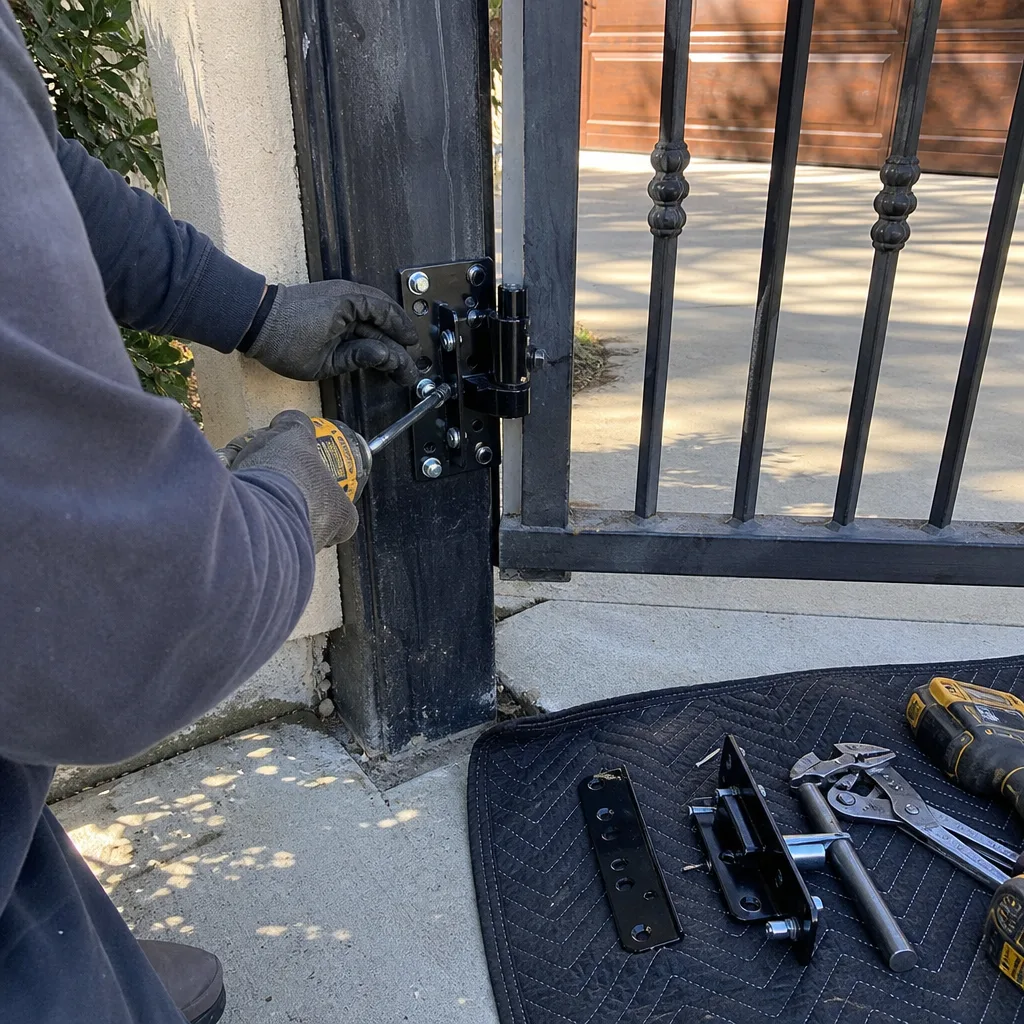
- Three-system diagnostic – We inspect all three layers: the mechanical hardware (hinges, wheels, track, chain), the electrical system (board, motor, capacitor, limit switches, wiring), and the safety system (photo eyes, edges, auto-reverse). This is the step most repair companies skip.
- Written price, agreed before work – You get a written price with parts and labor separated. The number on the invoice is the number agreed to at the door. Every time. No “while we were in there” add-ons.
- Repair and test – The work is completed and the gate is cycle-tested. For safety system work, we test auto-reverse with an obstruction tester, not just a hand wave.
- Photo documentation and digital invoice – You receive before-and-after photos, a description of what was found and what was fixed, and a digital invoice you can pay from a link.
- Written guarantee – Every repair carries the 365-Day Done Right Promise in writing: if the repair isn’t right, Calder makes it right, with a free second visit if it fails within the year.
Most residential gate repairs are completed in one visit. The exceptions are older or imported operators where a specific board needs to be ordered, which is where our broad brand training across electric gate repair in Orange County matters. The more brands we know, the less often we have to say “we’ll order it and come back.”
The Repair vs. Replacement Decision Tree
The honest math on repair versus replacement is something most gate companies won’t give you, because a replacement sale is worth more than a repair call. For a deeper look, see our DIY vs Professional Gate Repair: The Orange County Homeowner’s Decision Guide; here’s the framework we use with Orange County homeowners to make that call.
Repair makes sense when:
- The operator is under 10 years old, and the brand is still manufacturing parts.
- The repair cost is under 40 percent of the replacement cost.
- The gate structure itself (posts, hinges, wheels) is in good condition.
- You plan to stay in the home for at least three more years.
- The failure is a single component: one board, one limit switch, one capacitor.
Replacement makes sense when:
- The operator is over 15 years old AND the board has failed. The board is the first major component to die, and it’s rarely the last. A motor usually follows within two years.
- Multiple systems show significant wear: the motor is tired, the board is original, and the chain has stretched beyond adjustment.
- The repair estimate exceeds 50 percent of a new operator installed, especially if the new unit carries a longer warranty.
- The gate structure itself needs major work. If the post is sagging and the operator is old, you’re renovating, not repairing.
- You want newer safety features. Operators manufactured before 2016 often can’t support modern photo eye and monitored safety edge upgrades.
Here’s the decision tree in practical form:
- Is the repair under 40% of replacement cost? If yes, repair. If no, go to step 2.
- Is the operator 10 years or older? If yes, get a written replacement quote and compare it to the repair quote plus expected future repairs. If no, repair is likely the right call.
- Did the control board fail? If the board is dead and the operator is over 12 years old, replacement math usually wins. The motor and capacitor are not far behind.
- Do you want to add modern safety features? If the current safety system is outdated and the operator is old, replacement gets you current safety compliance without retrofitting.
We’ll run this math with you on the phone or at your gate in Orange County. We’re just as comfortable quoting a repair as a replacement, and the written price on either one is free.
What Gate Repair in Orange County Actually Costs (Line by Line)
Most gate opener repairs in Orange County run $180 to $650 before parts, depending on what failed and how long the diagnostic takes. For full pricing context, see our Gate Repair Cost Breakdown: The Orange County Homeowner’s Reference for 2026; here’s an honest line-item breakdown so you know what to expect before you call anyone.
| Repair Item | Typical Cost Range (Parts + Labor) | Time on Site |
|---|---|---|
| Diagnostic visit (credited toward repair) | $59 – $99 | 30 – 60 min |
| Limit switch replacement | $120 – $220 | 45 – 90 min |
| Capacitor replacement | $90 – $160 | 30 – 45 min |
| Remote receiver / antenna repair | $110 – $200 | 45 – 60 min |
| Control board replacement (LiftMaster) | $250 – $450 | 60 – 90 min |
| Control board replacement (FAAC / BFT) | $350 – $650 | 60 – 120 min |
| Hinge bearing replacement (per pair) | $150 – $300 | 60 – 90 min |
| Chain and sprocket replacement | $180 – $380 | 90 – 120 min |
| Motor replacement (residential swing or slide) | $450 – $1,200 | 90 – 180 min |
| Photo eye alignment or replacement | $90 – $180 | 30 – 60 min |
| Safety edge replacement | $140 – $260 | 45 – 90 min |
These are Orange County market prices based on what we quote and what we see from other local companies. Coastal communities can run 10 to 20 percent higher for parts-heavy work due to corrosion-related additional labor. The diagnostic fee is credited toward the repair if you proceed, so the true cost of finding out what’s wrong is zero if we fix it on the same visit.
Every Calder Gate Repair quote is written and agreed before any work starts. If we find additional issues during the repair, we stop, show you, and get your approval on a revised written price before continuing. No surprises.
For a full breakdown of pricing across all repair types, see our guide to gate opener repair in Orange County.
Safety Systems: The Layer Most Technicians Never Explain
Here’s the uncomfortable truth about gate safety: a gate without a functioning safety system is a machine with the potential to cause serious injury or death. Gates exert hundreds of pounds of force at the leading edge, and UL 325 safety standards exist because people have been hurt. A gate that continues closing when someone is in the path is not “a little unsafe.” It’s a hazard on your property, and you carry the liability.
Since 2001, all automatic gate openers sold in the United States must include two forms of entrapment protection: a primary device (photo eyes or contact sensors) and a secondary device (inherent auto-reverse). The photo eyes are the small sensors mounted on either side of the gate opening. The auto-reverse system is what makes the gate stop and reverse when it hits resistance.
We replace more photo eyes in Orange County than any other single safety component. Coastal corrosion kills the wiring. Mowers nick the cables. Gardeners accidentally kick the housing out of alignment. When a photo eye fails, the gate defaults to either not closing at all or closing without obstruction detection, depending on the system. Both are bad.
Given the serious injury risk posed by gate entrapment, we recommend having a trained, licensed professional inspect and service your gate’s safety systems. Do not bypass or disable photo eyes or safety edges to make a gate close. The liability sits with you, the homeowner.
If your gate opener predates 2016, it may not have monitored photo eyes, which self-detect a malfunction. Non-monitored sensors can fail silently, leaving your gate without entrapment protection while it continues to operate. That’s a good reason to upgrade the opener, not just the sensor. Ask your technician whether your photo eyes are monitored or non-monitored. If they can’t answer that question, call someone else.
Preventive Maintenance: What to Check Every Season in OC
A $150 annual inspection is cheaper than a $600 emergency repair, and in Orange County’s climate, seasonal checks matter more than the national average. Here’s what to look at four times a year, based on the stressors in your specific microclimate.
Spring (Match the rainy season’s end)
- Check the gate movement after winter rains. Water intrusion into the operator housing is the number one spring failure.
- Inspect chain tension. Rain and temperature shifts affect chain stretch.
- Clean the photo eye lenses. Spring pollen and rain splatter reduce their range.
- Check for rust blooms on hinges and hardware, especially within three miles of the coast.
Summer (Peak heat stress)
- Listen for motor strain. A motor laboring on a hot afternoon is a warning sign of early capacitor or motor wear.
- Check the operator housing temperature. If the enclosure is too hot to touch at 2:00 PM, ventilation may be inadequate.
- Keep the track clear of landscape growth. Summer growth narrows the path and adds friction.
- Test the auto-reverse once a month with a solid object, not a hand wave.
Fall (Pre-Santa Ana winds)
- Clear debris from the track and chain area before the winds blow all of it into the mechanism.
- Check all visible wiring for sun-cracking or animal damage. Rodents love gate housing in October.
- Lubricate hinges with a dry lubricant in canyon areas. In coastal areas, use a marine-grade grease.
- Verify that the gate closes completely and latches. A gate that stops two inches short is a safety gap and a structural stressor.
Winter (Post-daylight savings)
- Test safety edges and photo eyes more frequently. Shorter days mean more gate cycles in low light.
- Check for moisture inside the operator housing after the first rain.
- Inspect the keypad for button wear. Coastal salt and inland heat both shorten keypad life.
- Review the written guarantee from your last repair. The 365-Day Done Right Promise means if something failed, the follow-up visit is free.
If the list above makes you want to hand the clipboard to someone else, call Calder Gate Repair at (831) 603-6424. We’ll do the full seasonal walkthrough and give you a written list of what’s fine, what’s wearing, and what it costs to fix it. No obligation, free estimate, and a live person answers the phone 24/7.
Common Mistakes to Avoid
- Incomplete diagnostics that ignore the root cause. Most technicians replace the failed electrical component and never check the mechanical wear that caused it. Six months later, the same failure returns, and you pay twice.
- Using oil-based lubricants on chains in canyon or inland areas. Oil attracts dust and creates an abrasive paste that shortens chain and sprocket life. Use dry lubricants in dusty Orange County microclimates.
- Skipping the seasonal check because the gate “seems fine.” A gate can operate normally for months while a hinge is failing and overloading the motor. The first visible symptom is often the $900 failure.
- Bypassing safety features to make a gate close. Disabling photo eyes or safety edges removes entrapment protection and puts the liability on you. A gate that won’t close is telling you something; don’t mute the message.
- Hiring by hourly rate rather than written scope. An open-ended hourly repair can cost more than a fixed-price repair with a clear parts list. Always get the written price before work starts.
- Replacing an old board on a 15-year-old operator without doing the math. The board is rarely the last failure on an old unit. A motor or capacitor is usually next, and you’re better off replacing the operator once than paying for three separate repairs.
- Not knowing your opener brand and model before calling. FAAC and BFT parts can take a week to order. Knowing the model number saves a diagnostic round trip and gets the part ordered before the technician arrives.
See the difference
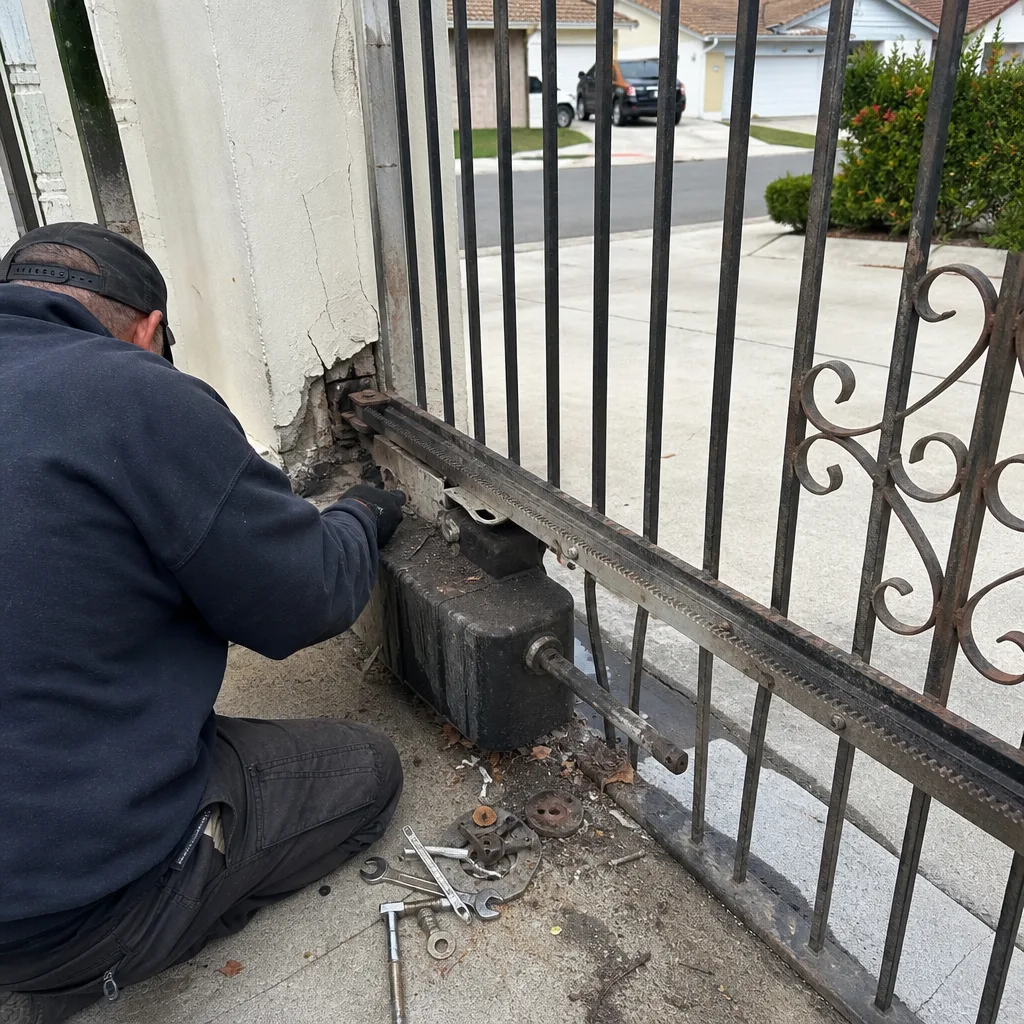 Before
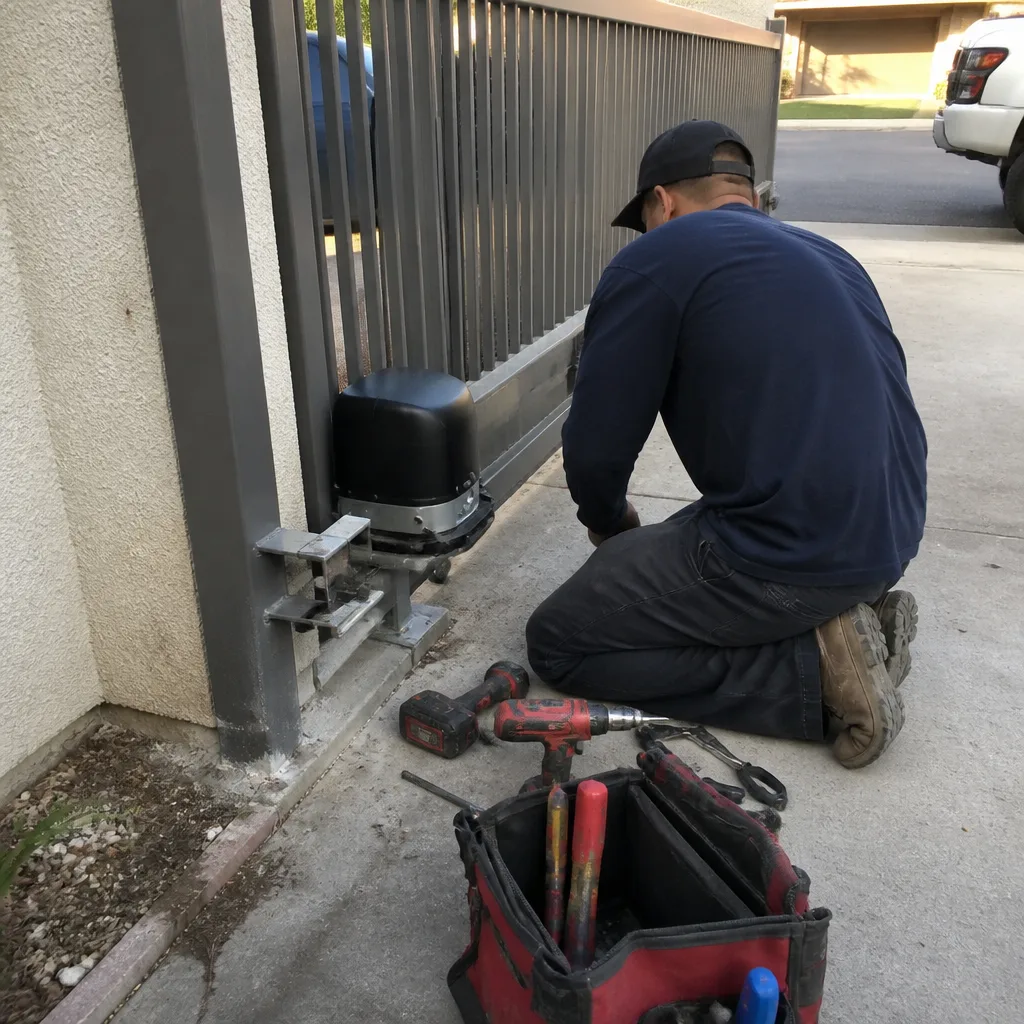 After
After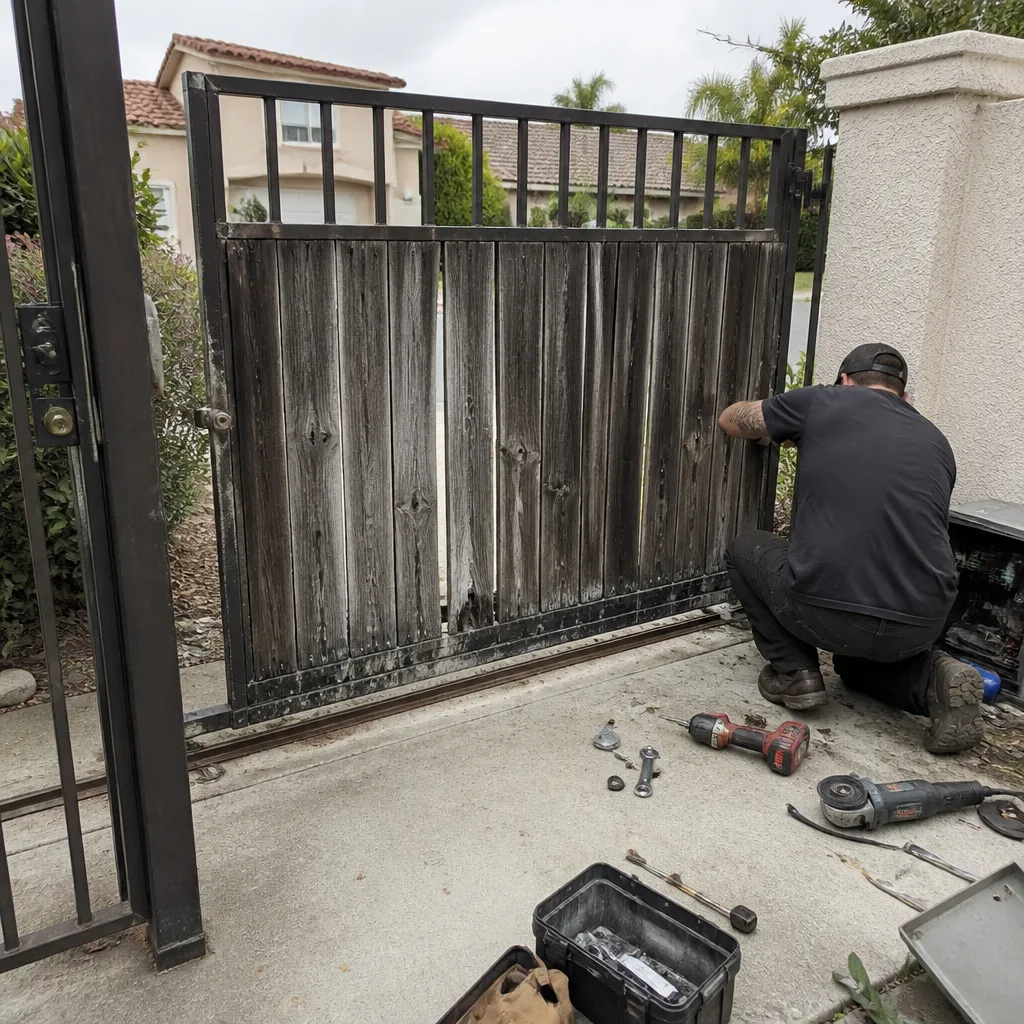 Before
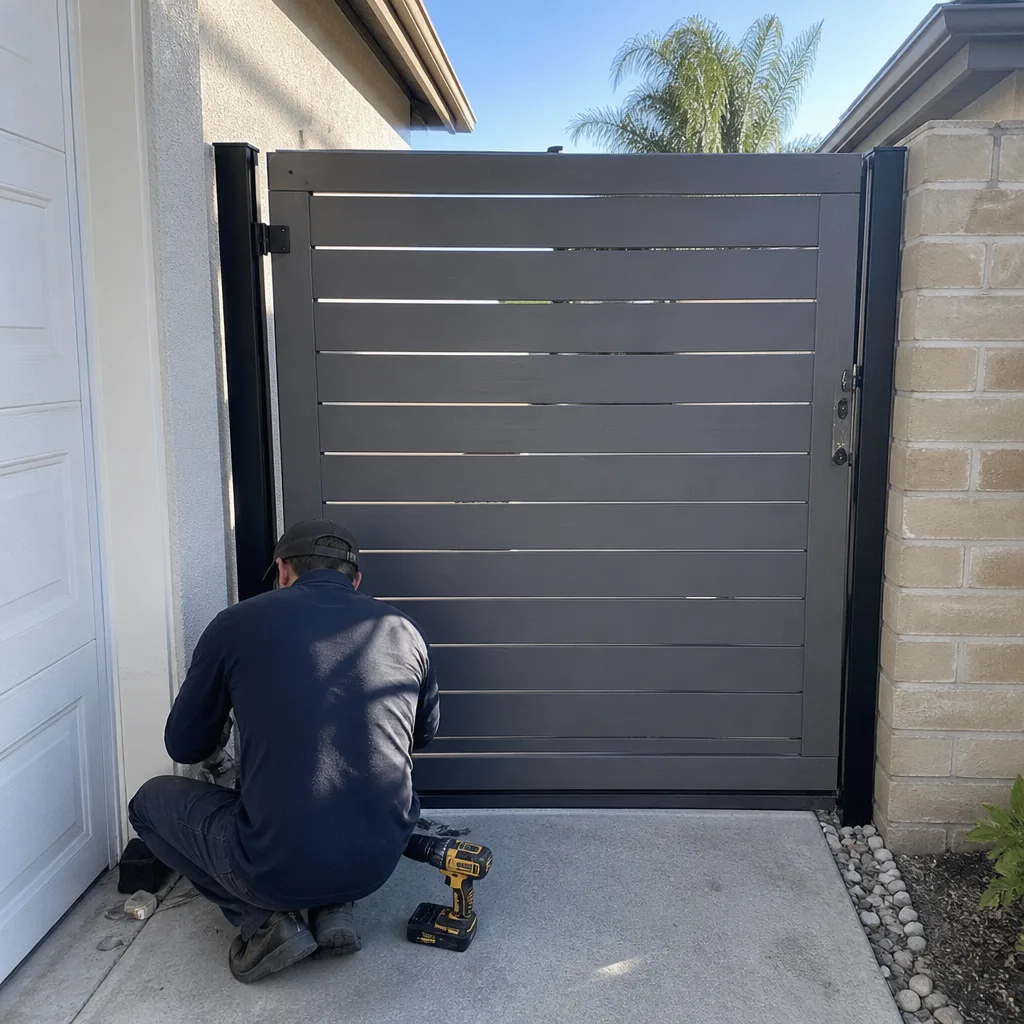 After
After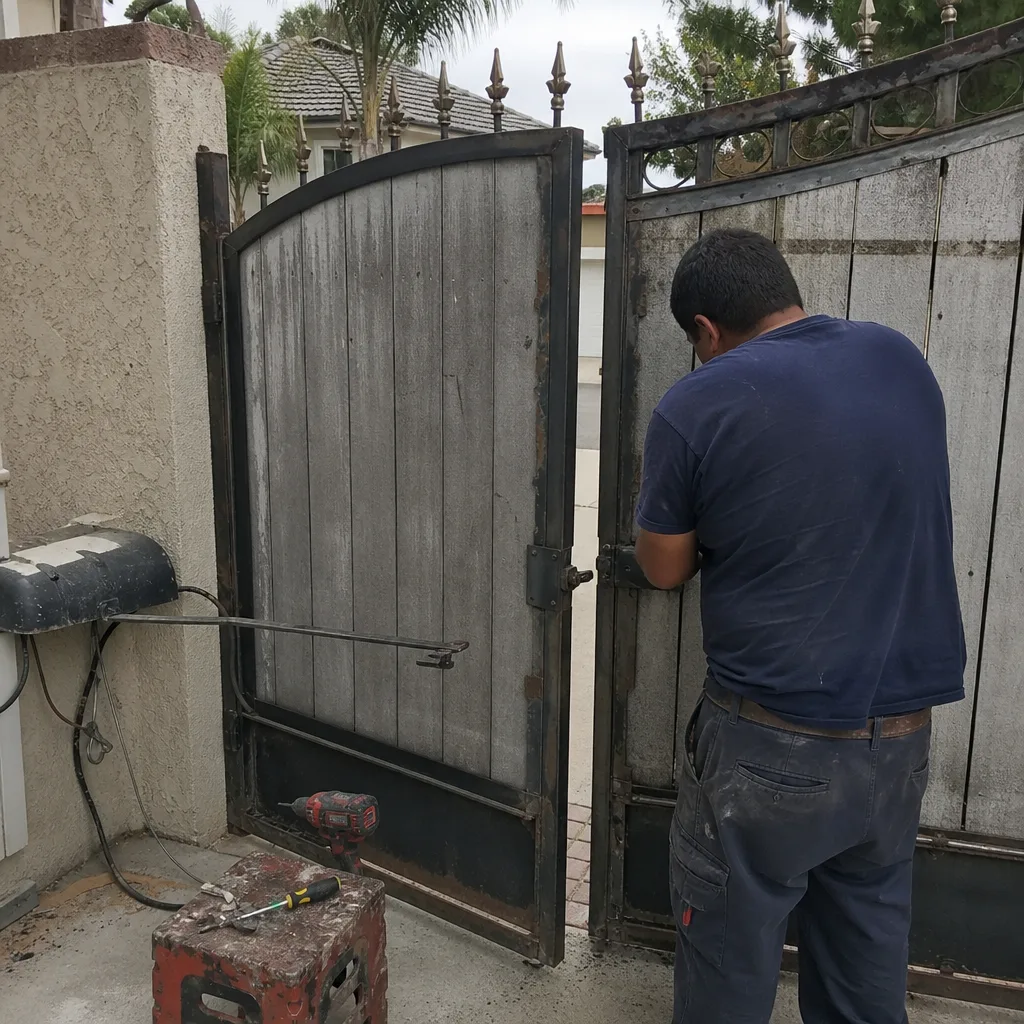 Before
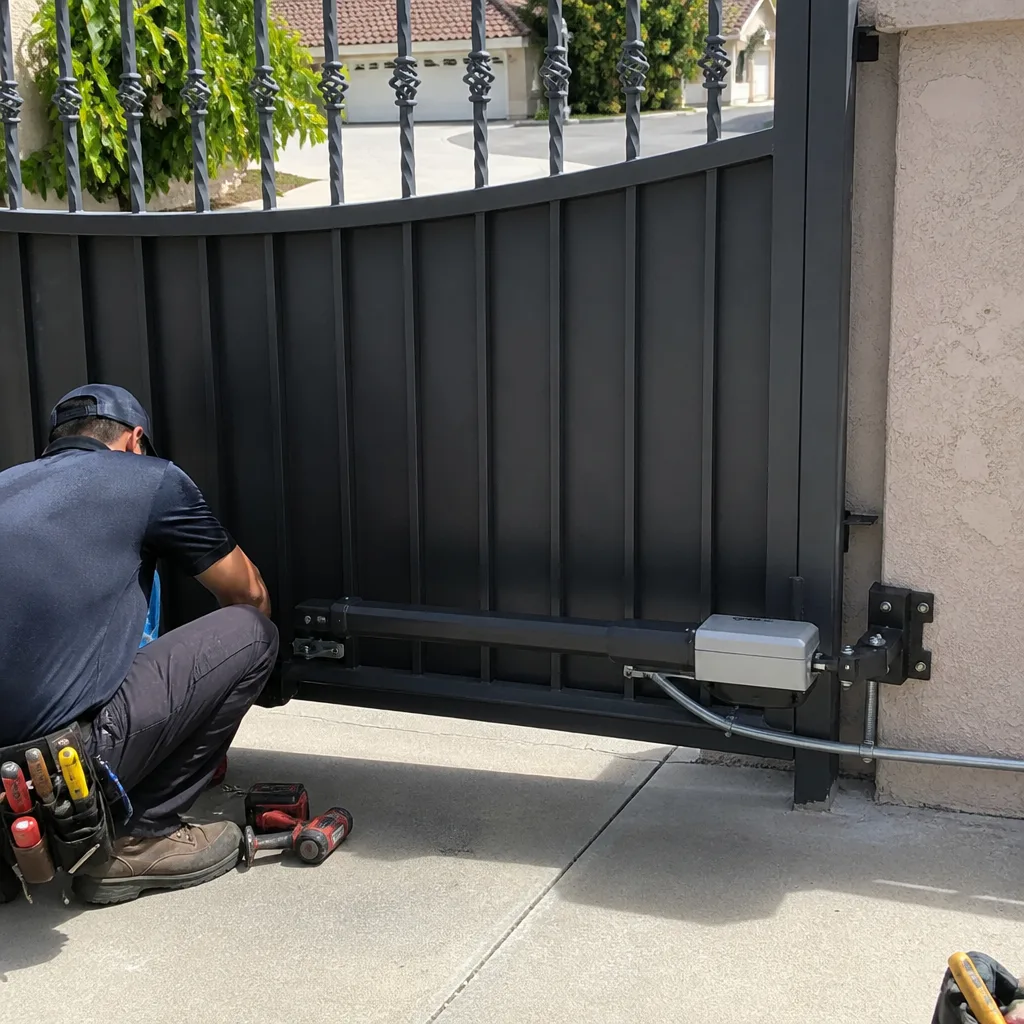 After
AfterWhen to Call a Professional
Some gate issues are safe to observe, but most require a professional with the right training and tools. Call a pro if your gate reverses on its own, moves unevenly, makes grinding or groaning noises, trips a breaker, or won’t respond to remotes or keypads. Any sign of sagging hinges, loose posts, or persistent rattling is a mechanical issue that will eventually damage the operator. Safety system failures, including photo eye faults or a gate that doesn’t auto-reverse, should be addressed immediately by a trained technician. Calder Gate Repair Orange County offers free estimates in Orange County. Call (831) 603-6424 and a live person will answer, 24/7.
Frequently Asked Questions
Most gate repairs in Orange County run between $180 and $650 including parts and labor, with motor replacement at the top end between $450 and $1,200 depending on brand. The exact price depends on the failed component, the opener brand, and the extent of mechanical wear contributing to the failure. Call (831) 603-6424 for a free estimate, and you’ll get a written price before any work starts.
Calder Gate Repair offers same-day service for emergency gate repair in Orange County, with a background-checked, uniformed technician dispatched with a live, trackable arrival time. A live person answers our calls 24 hours a day, so you won’t wait on hold or deal with a voicemail when your gate is stuck open. Call (831) 603-6424 and we’ll get someone out to you.
Our technicians are factory-familiar with nine major opener brands including FAAC, BFT, LiftMaster, Linear, Viking, Ghost Controls, DoorKing, Elite, and Mighty Mule. If you know your model number, share it when you call and we’ll confirm parts availability before dispatch. Call (831) 603-6424 for a free estimate on any brand.
In coastal Orange County neighborhoods with salt air exposure, gate motors average eight to twelve years. Inland units in Yorba Linda or Lake Forest often last ten to fifteen years with regular maintenance. The motor’s lifespan depends heavily on whether the mechanical system is maintained; a neglected hinge can cut motor life in half. If your motor is over ten years old and you’re facing a board replacement, ask for the repair versus replacement math before committing.
Every Calder Gate Repair job includes a written guarantee: if the repair isn’t right, Calder makes it right. If the repair fails within 365 days, we return at no charge. The promise is stated in writing on every job, not buried in a warranty booklet. Call (831) 603-6424 to schedule service and you’ll see the guarantee on your invoice.
Yes, Calder Gate Repair installs and services photo eyes, safety edges, and auto-reverse systems on gates throughout Orange County. Given the significant injury risk from unmonitored safety devices, we recommend a professional inspection for any gate manufactured before 2016. We’ll assess your current entrapment protection and quote the upgrade as a written, no-surprises price.
The Bottom Line
Your automatic gate is three systems in one, and the number one mistake Orange County homeowners make is paying for a repair that only addresses one of them. Whether it’s salt air in Newport Beach, canyon dust in Anaheim Hills, or heat cycles in Yorba Linda, your local climate is actively wearing on all three layers. Knowing your opener brand, understanding the repair versus replacement math, and insisting on a written price before work starts are the three highest-value moves you can make. Calder Gate Repair Orange County brings trained, background-checked technicians who know nine major brands, answer live 24/7, and back every repair with the 365-Day Done Right Promise.
Written by Nico Alvarez, Owner at Calder Gate Repair Orange County, serving Orange County since 2009.