
Last updated October 16, 2026
 Wrought iron
 Wood & steel frame
 Farm & ranch
 Sliding driveway gates
 LiftMaster operators
Free on-site gate assessment - hinges, posts, and your LiftMaster or Nice gate operator checked before anything is quoted
The assessment is free and the quote is the invoice.
Get your free estimateGate Repair Permits, Codes & Inspections in CA: What You Need to Know
If your gate opener was installed before 2016 and has never been inspected, there’s a reasonable chance it doesn’t meet current California entrapment protection requirements. That’s not a scare tactic; it’s a practical observation from our work across Orange County, where we regularly find pre-2016 gate systems that still rely on obsolete safety logic or lack the photo eyes that current code demands. Why does that matter? Because if a gate ever injures someone, the question won’t be whether the opener still works. It’ll be whether you met the legal standard of care. In this guide, we’ll walk through exactly what California code requires, which repairs actually trigger a permit in Orange County jurisdictions, what UL 325 entrapment protection means in plain language, how HOA overlays add a second approval track, and what happens when unpermitted gate work surfaces during a home sale. By the end, you’ll know precisely what needs to happen on your property and when you can handle a repair without a permit.
Quick Answer
Most gate repairs in California do not require a building permit, but most gate installations and many motorized gate replacements do. The single most important code governing residential gates is UL 325, which mandates entrapment protection devices like photo eyes, contact edges, and force-sensing systems on every automatic gate opener. As of 2025, California references the UL 325 standard statewide, and Orange County cities like Anaheim, Irvine, and Santa Ana enforce it through their local building departments with occasional differences in how each interprets “like-for-like” replacement. If you’re fixing an existing opener, you usually don’t need a permit. If you’re installing a new gate or replacing the opener with a different type, assume you do until your city says otherwise.
Styles & brands we work with
Table of Contents
- What Triggers a Gate Permit in California vs. What Doesn’t
- UL 325 Explained: Entrapment Zones, Photo Eyes, and What the Code Actually Requires
- How Orange County Jurisdictions Interpret Gate Codes Differently
- HOA Overlays: The Parallel Approval Track in OC Planned Communities
- What Happens When Unpermitted Gate Work Is Discovered During a Home Sale
- Permit Costs, Timelines, and What a Typical OC Gate Project Looks Like
- DIY vs. Professional Gate Repair: Where the Liability Line Is
What Triggers a Gate Permit in California vs. What Doesn’t
California’s building code treats gates the way it treats most fixed property improvements: if you’re altering the structure in a meaningful way, you need a permit. If you’re repairing what already exists, you usually don’t. The practical distinction matters because homeowners frequently over- and under-estimate where their project falls. Here’s the breakdown we use when talking with Orange County clients.
Projects that generally do not require a permit in California:
- Replacing a broken hinge, wheel, or roller on an existing gate
- Replacing a gate opener circuit board, limit switch, or capacitor (repair-in-place)
- Swapping a failed safety photo eye for a working equivalent
- Re-welding a cracked weld on a metal gate frame
- Replacing a gate opener battery or transformer
- Adjusting the open and close limits or force settings on an existing operator
Projects that generally do require a permit:
- Installing a new motorized gate where none existed before
- Replacing a manual gate with an automatic swing or slide gate
- Replacing a gate opener with a different class or type (e.g., going from an AC swing arm to a DC sliding operator)
- Installing a new gate structure that changes the setback, height, or footprint from what was originally permitted
- Running new electrical conduit or a new dedicated circuit to a gate operator
- Installing a gate that will impact the public right-of-way or a corner lot’s sight-triangle in any Orange County city
There’s a nuance worth naming: some Orange County building departments treat a “like-for-like” opener swap as a repair, while others treat it as an installation. Anaheim’s building division, for example, has historically taken a more permissive view of direct manufacturer-to-manufacturer swaps, particularly when no structural alteration occurs. Irvine has tightened interpretation since 2022 in several neighborhoods we service, requiring a minor electrical permit when any new wiring is pulled, even if the opener itself is a direct replacement. Santa Ana’s approach tends to fall somewhere between the two, with an extra layer of scrutiny on gates that front public sidewalks because of pedestrian entrapment risk. The safe move is always to call your local building department and ask specifically: “Is a permit required for a like-for-like gate opener replacement at my address?” Write down the name of the person you speak with. That record matters later.
One more thing: if the gate is classified as a “vehicle barrier” or operates as a security gate for a commercial or multi-family property in Orange County, the permit path is almost always mandatory, and the inspection process includes a UL 325 compliance check as a condition of final approval. We cover that in the next section.
UL 325 Explained: Entrapment Zones, Photo Eyes, and What the Code Actually Requires
UL 325 is the safety standard from Underwriters Laboratories that governs automatic gate operators and other motorized barriers. Since 2000, it has been the backbone of gate safety enforcement in the United States, and California’s Electrical Code references it directly. If you understand nothing else about gate codes, understand this: UL 325 exists to prevent a gate from crushing, trapping, or dragging a person. Every requirement in the standard flows from that single objective. Here’s how it translates into the parts on your gate. Whether you’re dealing with a LiftMaster, FAAC, BFT, or Linear operator, the safety architecture is essentially the same, and Orange County inspectors look at the same core elements.
There are four entrapment zones on any automatic gate, and UL 325 requires a protected means to address each one:
- The pinch point – the area where the gate meets the fixed fence or post. This is the leading killer in gate accidents, usually a hinge-side pinch on swing gates. Protection: a contact edge or a continuous pressure-sensing device mounted along that edge.
- The pull-in zone – the space the gate sweeps across as it opens. This is unique to swing gates and is the reason you’ll see “warning: moving gate” signage on every compliant install.
- The gate bottom edge – where the gate meets the ground. A gap larger than 2.25 inches is non-compliant on pedestrian-accessible gates because a child’s foot can be dragged underneath.
- The gate opening itself – the clearance between the opening gate and a fixed object (a wall, a column, a parked car). Protection: photo eyes mounted across the opening.
Every automatic gate operator installed after 2016 must include at least one primary entrapment protection device and one secondary device, often referred to as “monitored” protection. Monitored means the opener checks that the device is present and functional before each run cycle. If a monitored photo eye goes dark, the opener should refuse to run, or run only in a limited “hold to run” mode. That’s the law; it’s not optional. In our experience, the most common UL 325 violation we encounter in Orange County is a gate where a previous owner disconnected a finicky photo eye because it kept triggering false reversals. The gate works fine, but it no longer meets code, and the owner is now legally exposed.
How to check compliance without an inspector:
- Look for photo eyes about 6 to 12 inches off the ground on both sides of the gate opening. There should be a sender and a receiver.
- With the gate closed, place a solid object (a cinder block or a portable bike rack works) in the path of the photo eye beam. Press the remote. The gate should not start, or it should immediately reverse.
- Check for a contact edge along the leading edge of the gate and along the hinge-side pinch point on swing gates. It should compress visibly when you push on it.
- Open and close the gate. Use your hand to press the contact edge as the gate moves. The gate should reverse direction immediately when you press it. Wear gloves and stand out of the travel path while doing this.
- Look for a minimum ground clearance of 2.25 inches below the bottom edge of the gate across its entire travel path. Use a 2×4 as a rough gauge; a 2×4 on its side is exactly 1.5 inches thick and should slide through without scraping.
- Listen to the opener when it reaches the full open or full close position. A properly calibrated operator should reach its limit and stop with a distinct limit-switch click, not a hard, lurching stop against the post.
If your gate fails any of those checks, it does not meet current UL 325 entrapment protection requirements, and you should treat that as a legitimate safety and legal issue, not a cosmetic one. This is exactly the kind of gap our Gate Repair services can close quickly. Our standard repair process in Orange County includes a full UL 325 compliance check on every single visit, because an opener that runs is not the same thing as an opener that protects.
How Orange County Jurisdictions Interpret Gate Codes Differently
California’s statewide code is the floor, not the ceiling. Cities can and do add their own layers. Orange County’s patchwork of 34 cities means the same gate project can face different permit requirements, different inspection checklists, and different enforcement philosophies depending on which city hall you’re dealing with. This difference is not theoretical; it shapes real decisions for homeowners from Fullerton to San Clemente. If you’re in central or north Orange County, you’re usually dealing with Anaheim, Irvine, or Santa Ana building departments, each with its own approach.
Anaheim tends to be the most repair-friendly of the three. For a straightforward gate opener circuit board replacement or a like-for-like FAAC swing arm swap, Anaheim’s inspectors generally consider the work a “maintenance repair” under the California Residential Code, which avoids the permit trigger entirely. However, Anaheim is strict about anything touching the public right-of-way. If your gate opens over a sidewalk or is within the city’s designated sight-triangle setback, they will require a permit and a mandatory on-site inspection. The inspector will specifically check that the gate opens inward away from the sidewalk, that the photo eye is mounted outside the right-of-way line, and that the ground clearance meets the 2.25-inch standard.
Irvine has become the most detail-oriented of the three in our experience, driven in part by the density of master-planned communities and the volume of HOA-governed gate projects. Irvine’s building division currently requires an electrical permit for any gate opener replacement that involves new conduit, a new disconnect switch, or a new circuit. They also enforce a local amendment requiring that any automatic gate serving more than four residential units have an annual self-inspection log maintained by the operator, a requirement that catches a lot of HOA property managers off guard. For single-family homes, the practical effect is that a simple opener rebuild doesn’t trigger anything, but a full operator replacement plus new wiring almost always does.
Santa Ana splits the difference. Single-family residential gates get treated similarly to Anaheim’s approach: repair-in-place work is generally permitted without a permit. But Santa Ana’s building department has a long-standing vigilance about gates on corner lots and gates that open toward any public walkway. They also maintain a stricter interpretation of what counts as a “new installation” when a homeowner replaces a sliding gate with a swing gate, even if the opener brand (say, a Linear operator swapped for another Linear) remains the same. In our conversations with Santa Ana inspectors, the test they apply is whether the physical configuration of the gate changed. If the answer is yes, they want a permit.
The practical takeaway: before you schedule any gate work in Orange County that goes beyond a simple board swap, call your city’s building department and ask the permit question in writing. A quick email is fine. Save their reply. It takes ten minutes and eliminates a surprising amount of downstream liability.
HOA Overlays: The Parallel Approval Track in OC Planned Communities
If you live in a master-planned community in Orange County, you already know that HOAs operate as a second government. What many homeowners don’t realize is that HOA approval is a parallel process, not a substitute for a city permit, and not a replacement for UL 325 compliance. You may need all three: city permit, HOA approval, and code-level safety compliance. In communities like Ladera Ranch, Rancho Mission Viejo, and the Irvine Company neighborhoods (Woodbury, Northwood, Portola Springs, and similar), gate projects almost always require an architectural application before any street-facing work begins.
The HOA approval process in these communities typically works like this:
- Submit an exterior modification request. Include the gate’s material, color, height, and opening direction. Most Irvine Company communities require a site plan sketch showing the gate’s relationship to the street and neighboring properties.
- Wait for the architectural review committee. Timeline varies by community, but four to six weeks is common in Ladera Ranch; Irvine neighborhoods tend to be faster at three to four weeks when all documents are submitted correctly at once.
- Receive a conditional approval. The condition usually states that the work must comply with all applicable city codes and that a final inspection certificate must be filed with the HOA management office within 30 days of completion.
- Complete the work and pass the city inspection. The city inspector signs off on the permit and the UL 325 compliance elements.
- Submit the final inspection sign-off to the HOA. This closes the loop. Skip this step and the HOA has a file note that will surface when you sell the house.
Two common friction points we see in Orange County planned communities: First, the HOA’s landscape committee sometimes objects to gate colors or materials that don’t match the community’s design palette. A raw steel gate with visible welds, even if structurally perfect, can be rejected on aesthetics. Second, the HOA may require a specific setback from the street that is more conservative than the city’s minimum. In Irvine Company neighborhoods, gate posts must often sit several feet behind the front setback line, which can shrink the usable driveway area. Getting city approval first, then HOA approval, is usually the wrong order. The HOA application should go in first because their design constraints can change your site plan before the city ever sees it.
If you’re repairing an existing gate rather than replacing it, HOA approval is generally not required in Orange County communities. But there’s an exception worth naming: if the repair changes the gate’s appearance (new paint color, new gate surface material, a taller operator post), the HOA may classify it as a modification and require an application. We’ve seen homeowners repaint a black iron gate in a matte bronze finish and then get a compliance letter from the property management office. When in doubt, read the community’s architectural guidelines before you touch the gate’s appearance.
What Happens When Unpermitted Gate Work Is Discovered During a Home Sale
This is the section most permit guides skip, and it’s the one with the most real financial consequence for Orange County homeowners. During a home sale, the buyer’s disclosure process typically includes a review of the property’s building permit history. If the seller discloses a motorized gate that is not in the city’s permit records, or if the buyer’s home inspector flags an unpermitted gate installation during the physical inspection, the deal enters a specific negotiation corridor. Understanding what happens next helps you decide whether to address the issue now or later.
In a typical Orange County transaction, the discovery of unpermitted gate work triggers one of four outcomes:
- The buyer requests a retrofit permit. The seller applies for a permit after the fact, brings the gate into current code compliance (which may involve adding missing photo eyes, a contact edge, or a new operator), and pays for the inspection and any corrections. Cost: typically $600 to $2,200 depending on what’s missing.
- The buyer requests a price reduction. A common reduction in our experience is the estimated cost of bringing the gate into compliance plus 20 percent for “hassle factor.” On a gate that needs a full operator replacement to meet UL 325, that can mean a $3,000 to $6,000 discount at close.
- The buyer walks away. This happens most often with older gates that don’t meet current ground clearance or that lack any entrapment protection. A gate that hasn’t been updated since 2005 often can’t be economically retrofitted, and the buyer’s lender may flag it as a safety defect that blocks financing.
- The deal proceeds with no action. This is less common than you might think in Orange County’s current market, where many buyers have a home inspector who knows exactly what unpermitted gate work looks like: fresh welds on gate posts, a new operator box that doesn’t match the property’s age, or conduit running along a fence line that doesn’t appear in the listing photos.
The cleanest way to avoid this scenario is to handle gate compliance on your timeline, not during a 21-day inspection contingency. If you’re not selling, but you know your gate opener predates 2016 and has never been inspected, the proactive move is a professional compliance check now-see our Gate Repair Warning Signs: A Orange County Homeowner’s Reference Guide for what to watch for. It’s less expensive than any of the four outcomes above, and it closes the one liability gap that doesn’t show up in a standard home inspection checklist.
One more disclosure-related point: California’s statutory seller disclosure form (the TDS) asks specifically about “any known material facts or defects affecting the property.” A gate that doesn’t meet UL 325 entrapment standards is a material defect in our view, and most Orange County real estate attorneys we’ve spoken with agree. Disclose it, fix it, or risk the buyer discovering it independently. Those are the choices.
Permit Costs, Timelines, and What a Typical OC Gate Project Looks Like
Budgets and calendars matter as much as codes. Here’s what a typical gate project with permit requirements looks like in Orange County as of 2025. The numbers are ranges based on current market rates we see across Orange County, not quotes; your specific project will vary based on property size, gate type, and distance from a city inspection route.
City building permit fees (Orange County ranges):
| Permit Type | Typical OC Range | Notes |
|---|---|---|
| Residential gate permit (structure only) | $145 – $410 | Anaheim is on the lower end; Irvine is on the higher end |
| Electrical permit (gate opener power run) | $90 – $280 | Required if any new wiring or a new circuit is installed |
| Combined gate + electrical permit | $220 – $600 | Most common permit package for full installations |
| Retrofit permit (after-the-fact) | $180 – $550 | Often includes penalty multipliers in some OC cities |
| Inspection re-visit fee | $75 – $150 per visit | Charged when the inspector has to come back after a fail |
Timeline expectations:
- Over-the-counter permit issuance (repair-level electrical work): same day to 3 business days
- Standard residential gate permit with plan review: 2 to 4 weeks in Anaheim, 3 to 6 weeks in Irvine, 2 to 5 weeks in Santa Ana
- Inspection scheduling after the work is complete: 2 to 7 business days depending on the city’s current volume
- Total timeline from permit application to final sign-off: 4 to 10 weeks for a typical new automatic gate installation in Orange County
What a full gate installation sequence looks like from our side: we submit the permit application with a site plan and a UL 325 compliance specification sheet, schedule the rough inspection after the gate posts are set and the conduit is run, complete the opener installation and safety device commissioning, schedule the final inspection, and then walk the property with the city inspector. Any correction items identified at the final inspection are corrected on the spot in most cases, then re-inspected. A well-prepared project passes the final inspection on the first visit 90 percent of the time or better. The failures we do see are almost always missing contact edges on the hinge-side pinch point or photo eyes that are mounted too high to detect a small child.
For homeowners who are not planning a full installation but need a gate opener repair, the permit question usually disappears. Replacing a failed LiftMaster or Viking control board, rebuilding a BFT hydraulic arm, or re-soldering a broken limit switch wire is repair work under California’s code, and no permit is triggered. The gate still has to meet UL 325 safety standards, which is why our standard repair includes a compliance check on every job. Permits are for construction; safety standards are for every gate that moves.
DIY vs. Professional Gate Repair: Where the Liability Line Is
There are gate repairs a capable homeowner can absolutely handle. Replacing a remote control, re-aiming a misaligned photo eye, greasing hinges, tightening gate post bolts, swapping a dead battery in a keypad, these are all within reach with basic tools and a little patience. There are other gate repairs that no homeowner should attempt, and the dividing line is not tool difficulty. It’s liability. If you work on the parts of the gate that are designed to prevent injury, and the gate later injures someone, you are the manufacturer of the condition. That’s not a hypothetical; it’s how California premises liability law actually operates.
The parts of a gate system we consider beyond the DIY line:
- Gate springs and counterbalance mechanisms. A swing gate under spring tension stores enough energy to break a hand or a jaw if it snaps during disassembly.
- The opener’s internal force calibration. Setting the force too high so the gate pushes through resistance rather than reversing is how entrapment injuries happen. A trained professional uses a force gauge and follows the manufacturer’s UL 325 test procedure.
- Any wiring that crosses from the house to the gate. A gate opener circuit should be a dedicated 20-amp circuit with a GFCI-protected outlet at the operator. Getting this wrong creates both a fire risk and a code violation that will show up in a home inspection.
- The physical gate structure itself. A gate that weighs 600 to 1,200 pounds, which is typical for an Orange County iron driveway gate, can kill someone if it falls during an adjustment. Gate post shimming and re-welding are professional work, always.
- Any safety device you’re reinstalling because it failed. A photo eye that repeatedly trips might be misaligned, or it might be a failing control board that’s intermittently losing the supervisory signal. Replacing the wrong component leaves the gate unprotected and you exposed.
Our recommendation is simple. If your repair involves the opener’s safety controls, the gate’s structural components, or any spring or tension assembly, call a professional. The cost of a same-day repair is usually $180 to $340 before parts for most Orange County gate opener issues, which is a rounding error compared to what a serious entrapment injury costs in California courts. And if you’re not sure whether your gate meets current UL 325 standards, a professional compliance check is the fastest way to get a clear answer. We at Calder Gate Repair Orange County home do these checks daily across Orange County, and the answer is often simpler than homeowners expect.
Common Mistakes to Avoid
- Assuming “like-for-like” replacement never needs a permit. In Irvine and parts of Santa Ana, changing the operator type or pulling new wire changes the classification. Confirm with your city before you start.
- Disconnecting a photo eye that keeps false-tripping. This is the single most common UL 325 violation we find in Orange County. A professional can usually fix the actual cause (bad alignment, dirty lens, failing board) without disabling the safety device.
- Skipping the HOA application because you’re “just repairing” a gate. If the repair changes the gate’s appearance or operator post, several OC planned communities require an architectural review.
- Believing that a gate that opens and closes reliably is code-compliant. Pre-2016 openers can work perfectly while completely failing modern entrapment protection standards. Function and compliance are two different measurements.
- Using a non-monitored safety device. A non-monitored contact edge meets the letter of old code but not modern UL 325. If the opener can’t verify the device is present before each cycle, it’s not a compliant installation.
- Not documenting pre-2016 gate work before selling. If your home has an older gate that was never permitted, gather what records you have now. A complete paper trail (even a repair invoice with photos) is far better than nothing when a buyer’s inspector asks questions.
- Relying on a general handyman for opener safety wiring. Gate opener safety circuits require specific low-voltage wiring practices and UL-rated components. A handyman who’s not factory-familiar with the opener brand (whether that’s FAAC, BFT, Linear, or another) can create a code violation that’s invisible until an injury occurs.
See the difference
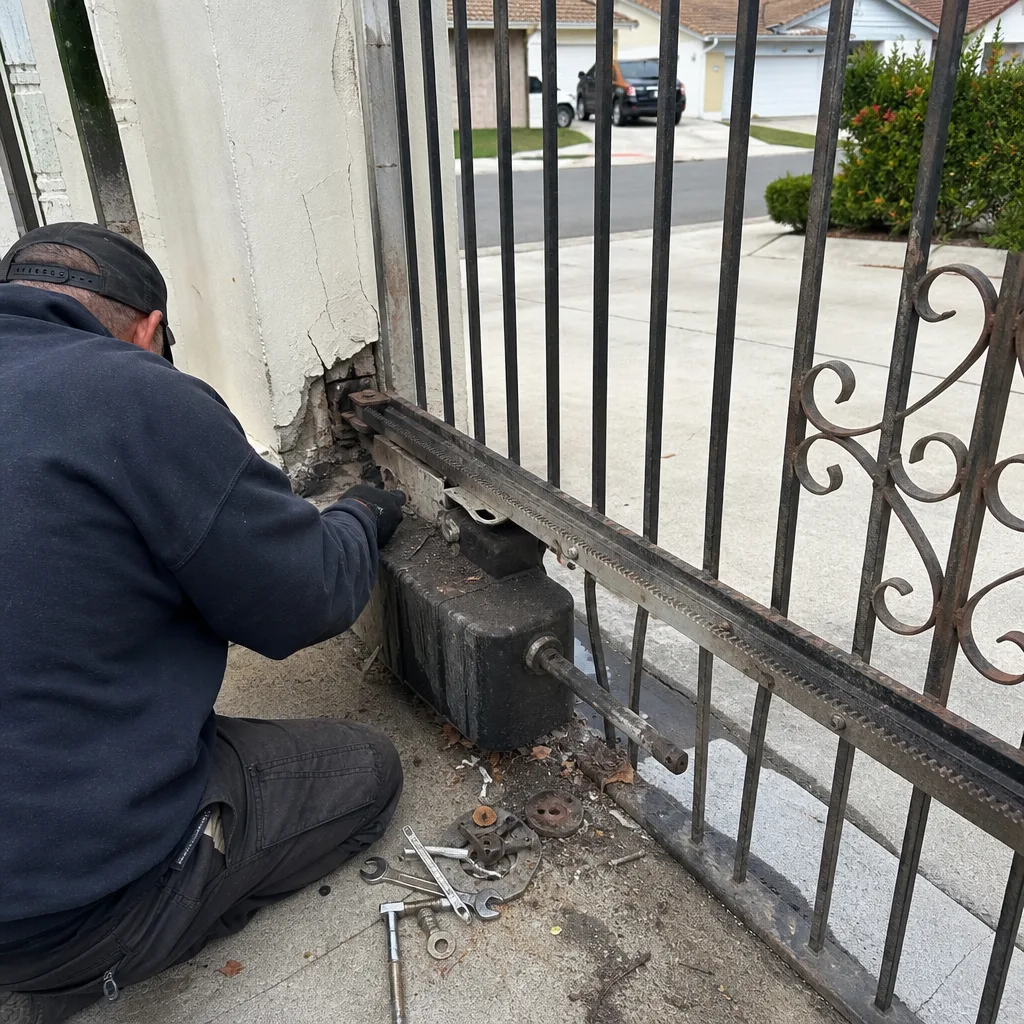 Before
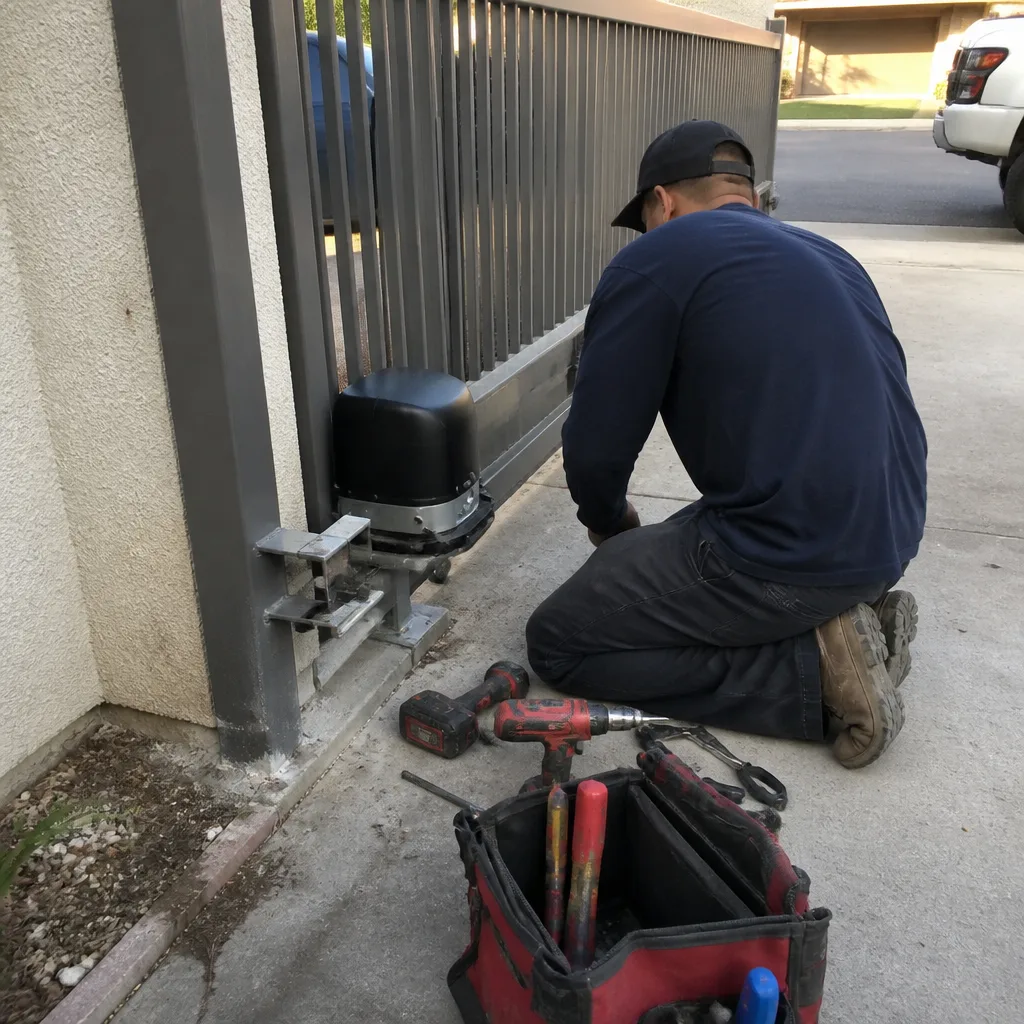 After
After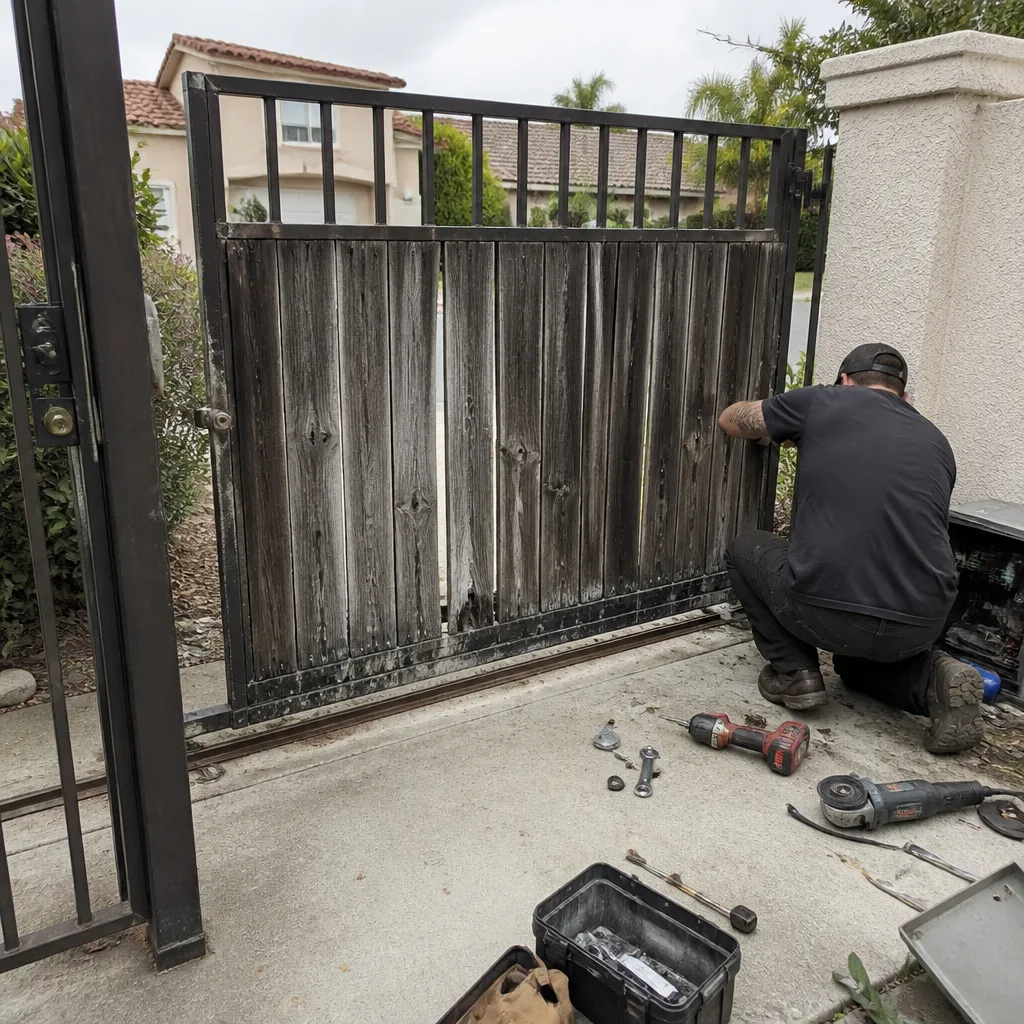 Before
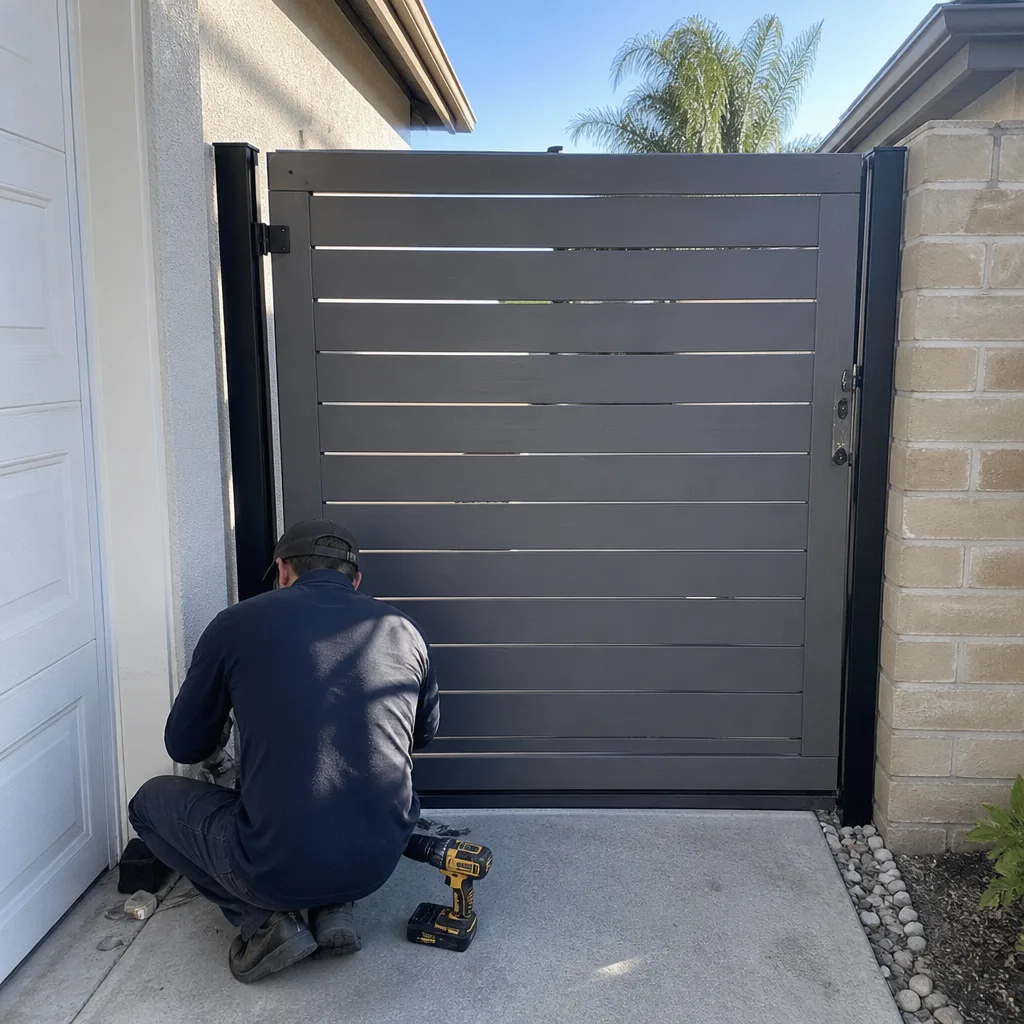 After
After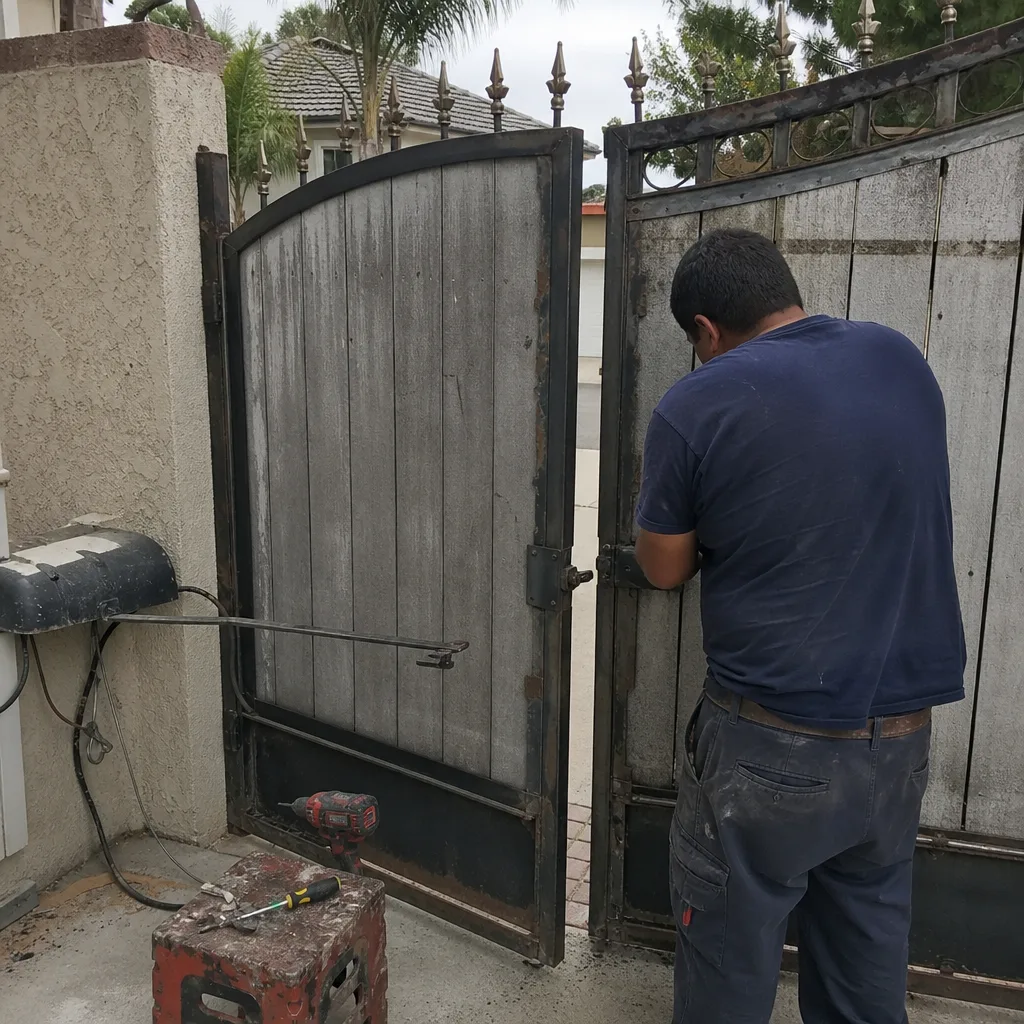 Before
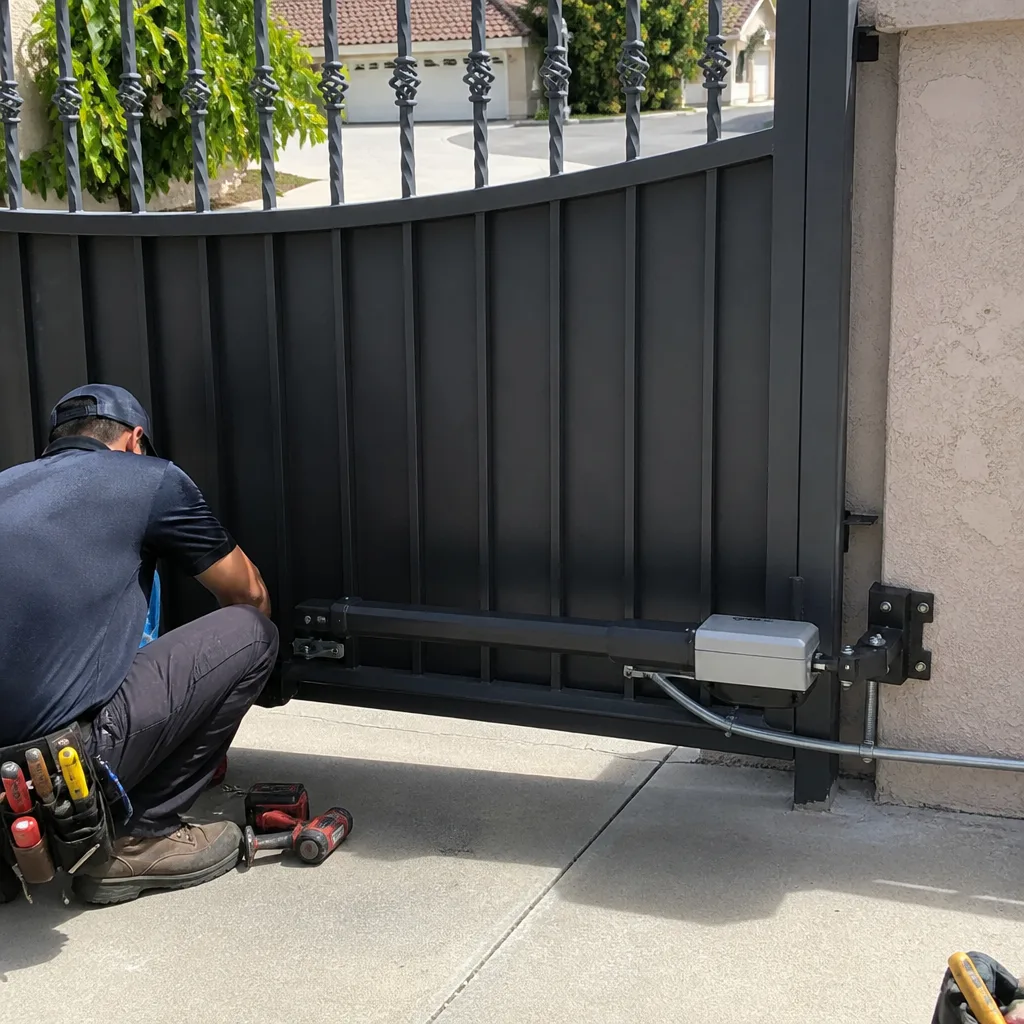 After
AfterWhen to Call a Professional
You should call a professional gate company when your gate fails any of the UL 325 compliance checks we outlined above, when the opener is more than ten years old and has never had a proper safety inspection, when you’re planning a new gate installation or a significant opener replacement, or when you’ve received a correction notice from your city or HOA. You should also call before you’re buying or selling a home with a motorized gate, even if everything seems to work. An inspection now is cheaper than a retrofit permit during escrow. If you’re in Orange County, Gate Repair in Orange County is what we do every day. We’re the dedicated gate repair specialist inside the Relay Home Co. family, and our Orange County dispatchers can usually get a technician to most of the county on the same day for safety-related repairs. The estimate is free, the price is in writing before any work starts, and every repair carries a 365-day guarantee with a free second visit if anything fails. Call (831) 603-6424.
Frequently Asked Questions
In most cases, no. Repairing an existing gate opener, such as replacing a control board or a limit switch, is considered maintenance and does not trigger a permit in California. However, installing a new operator type or running new electrical wiring usually does.
Yes. California’s Electrical Code references UL 325 for all automatic gate operators, and compliance is required for any new installation or opener replacement since 2016. If your gate predates that standard, it may still be operating legally if it was compliant at the time of installation, but the first time you replace the opener or the gate structure, you’ll be required to bring it into current compliance.
Expect to pay $220 to $600 for a combined gate and electrical permit in Orange County, with Anaheim on the lower end and Irvine on the higher end. A repair-level electrical permit alone runs $90 to $280 in most OC cities.
A monitored device sends a supervisory signal that the opener checks before each run cycle. If the device is missing or non-functional, the opener will not run, or will run only in a limited “hold to run” mode. A non-monitored device provides no such signal, which means the opener can run even when the safety device has failed. Current UL 325 requires monitored devices on all new installations.
Usually not, if the replacement doesn’t change the gate’s appearance or the operator post. But if the repair alters the gate’s color, material, height, or position, many Orange County planned communities, including Irvine Company neighborhoods and Ladera Ranch, will require an architectural application. Check your community’s guidelines before scheduling the work.
It depends on when it was installed and what code applied at the time. A pre-2016 gate that met the UL 325 standard in effect when it was installed may remain in service until a “trigger event” occurs, such as an opener replacement or a structural modification. But “grandfathered” never means “safe.” A gate that doesn’t meet current entrapment protection requirements is a liability risk even if it’s legally permitted to remain.
The Bottom Line
California gate regulations are less confusing than they appear once you separate the three layers: city permits (construction-level approval), UL 325 (safety compliance), and HOA overlays (design and community approval). Most repairs don’t need a permit, but every motorized gate must meet current entrapment protection standards regardless of when it was installed. In Orange County, the specific interpretations vary by city, with Irvine the most detail-oriented and Anaheim the most repair-friendly, but the UL 325 requirements are uniform across all 34 OC cities. If you own a gate that predates 2016 and has never been inspected, the single highest-value action you can take is a professional safety compliance check. It closes a liability gap, protects the people using your property, and keeps the gate running the way it was meant to. Need a Electric Gate Repair in Orange County technician to look at yours? We’re the Gate Opener Repair in Orange County team with the factory knowledge and the travel schedules to make it easy. Call (831) 603-6424 for a free estimate.
Written by Nico Alvarez, Owner at Calder Gate Repair Orange County, serving Orange County since 2009. Explore more guides & resources.